LIVE DATA — NOAA SWPC
Live Geomagnetic Storm — — Kp Index & Solar Wind
Short answer
A geomagnetic storm is a disturbance of Earth's magnetic field caused by charged particles streaming from the Sun. Its strength is measured by the Kp index from 0 to 9: Kp 0–4 is quiet, Kp 5 and above is a storm (G1–G5). The live panel below shows the latest Kp value from NOAA SWPC, the last 24 hours of readings and the aurora forecast.
Kp 0–9
3-hour scale
G1–G5
NOAA storm scale
SWPC
Official data source
24 hours
Measurement window
Live Kp Index
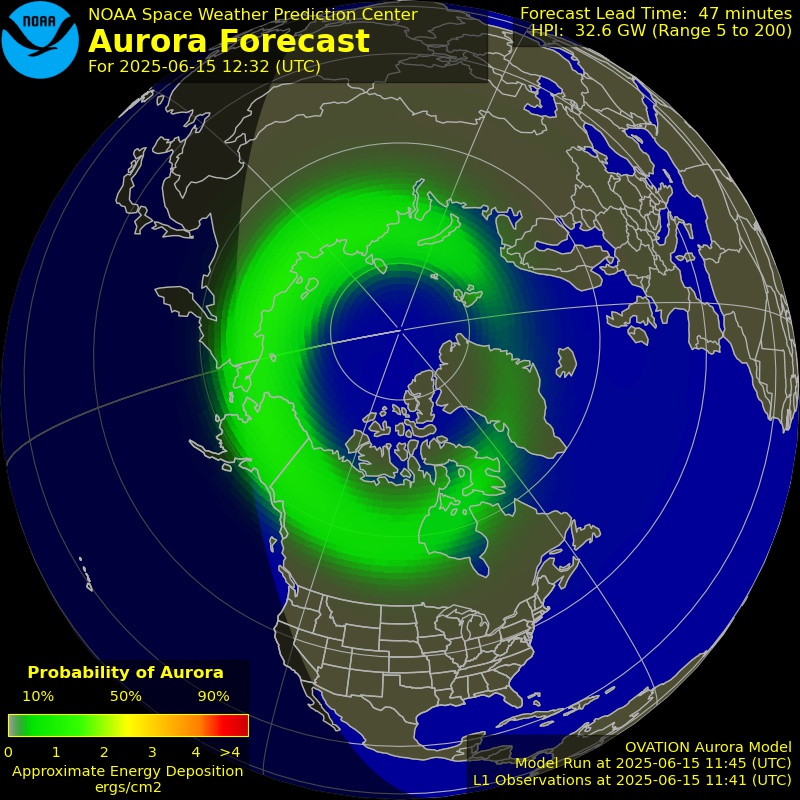
Aurora Forecast (Northern Hemisphere)
OVATION Prime model, refreshes ~every 30 min
What is the Kp index and how do you read the live value?
The Kp index is a global measure of how strongly Earth's magnetic field was disturbed in a 3-hour window. It runs from 0 to 9: values of 0–1 describe a fully quiet magnetosphere, while 9 marks the most severe measurable storm. The index is produced by combining data from 13 magnetic observatories around the world and is updated every 3 hours by NOAA's Space Weather Prediction Center (SWPC).
In practice, remembering three thresholds is enough: Kp 0–4 is a normal day with no noticeable effects. A value reaching Kp 5 marks the first storm level (G1), when auroras strengthen in polar regions and sensitive radio links begin to flutter. Values of Kp 7 and above are rare and are the levels at which satellite operators, power grids and aviation authorities issue formal warnings.
The live panel below shows the current Kp value, a 24-hour history and NOAA's official aurora forecast map. Data is read directly from NOAA servers; every page refresh brings you the latest measurement.
The G1–G5 storm scale: what each level means
The scale is real-time rather than retrospective: when G3 is declared, grid operators start monitoring transformer currents, polar flight routes can be rerouted and signal quality may drop for GNSS-based precision farming and construction. Around the peak years of the solar cycle (2024–2026 for cycle 25), G1–G2 storms can occur several times a month.
| Level | Kp equivalent | Frequency | Practical effect |
|---|---|---|---|
| G1 — Minor | Kp 5 | ~1,700 days per solar cycle | Weak auroras brighten; minor errors on sensitive satellite links |
| G2 — Moderate | Kp 6 | ~360 days per cycle | Auroras at high latitudes; HF radio signal fades |
| G3 — Strong | Kp 7 | ~200 days per cycle | Auroras may reach mid-latitudes; grid operators run checks |
| G4 — Severe | Kp 8 | ~100 days per cycle | Satellite navigation errors increase; grids enter protective modes |
| G5 — Extreme | Kp 9 | A few days per cycle | Grid failures possible; auroras dip to very low latitudes |
NOAA geomagnetic storm scale and practical effects
Does a geomagnetic storm affect health and daily life?
Technological effects are well documented: during storms GPS position error increases, HF radio and satellite links can drop out, and protective relays may act on long transmission lines. Turkey's grid infrastructure has automatic protection for these effects, and G1–G2 events do not disrupt daily life.
On the health side the picture is clearer: the scientific literature has not established a consistent, replicable causal link between geomagnetic storms and headaches, sleep disorders or heart-rhythm problems. The feeling of restlessness during storms is common, but there is no strong evidence separating that observation from placebo and expectation effects. This page does not give medical advice; it tracks the values as a technological and visual phenomenon.
For aurora hunting the best indicator is not Kp but the Bz component: when the interplanetary magnetic field turns southward (negative Bz), energy transfer accelerates. Short term, Kp + a dark sky is a good enough rule of thumb.
Can auroras be seen from Turkey?
Auroras form at latitudes close to the magnetic poles; Turkey's magnetic latitude sits in the 36–42° band and a typical G3 storm does not reach that far. However, in exceptional G5-class storms the auroral oval dips far south: during the historic May 2024 storm, auroras were photographed even from Turkey. Such events arrive years or decades apart.
A practical rule: when the auroral oval on NOAA's map dips south of northern Europe and the Kp reading is above 7, it may be worth trying long-exposure photos toward a dark northern horizon. Naked-eye visibility is far lower than photographic visibility; your phone's night mode is therefore the best aurora detector you own.
Data source, measurement method and freshness
The Kp values on this page come from NOAA SWPC's open data service; each row in that service is the global Kp average of one 3-hour window. The aurora forecast image is the latest output of the OVATION Prime model, refreshed roughly every 30 minutes. If the server cannot be reached, the panel says so explicitly — we never show fabricated data.
All data and images are presented for informational purposes only. For aviation, maritime, energy or medical decisions, the official sources — NOAA SWPC and the relevant national authorities — must take precedence. Content is current, but delays originating from the data source are possible.
Frequently Asked Questions
When does a geomagnetic storm happen?+
They are more frequent in the peak years of the solar cycle (2024–2026 for the current cycle 25). After a major solar eruption (an X-class flare or coronal mass ejection), the disturbance reaches Earth 15 hours to 3 days later. The live panel on this page shows the current Kp value; NOAA SWPC's 3-day forecast is the most reliable source.
What Kp index counts as a storm?+
Values of Kp 5 and above count as storms and are classified on the G1–G5 scale. Kp 4 and below is quiet. Kp 7 and above is strong; Kp 9 is the most severe measurable level.
Does a geomagnetic storm affect human health?+
No consistent causal link between storms and headaches, sleep or heart problems has been established in the scientific literature. The effects are mainly technological: GPS accuracy, radio links and power grids. Anyone with health concerns should consult their physician.
Can auroras be seen from Turkey?+
Not normally; however, in exceptional G4–G5 storms the auroral oval dips far south and can be photographed from Turkey on rare occasions (example: the May 2024 storm). The NOAA map in the live panel and Kp values above 7 are the best indicators.
Do storms affect the internet, phones or GPS?+
Mobile internet and normal phone calls are not affected. Radio communication can be cut on high-latitude flights, GPS accuracy can drift by meters and satellite operators can see temporary outages. G1–G2 events are not noticeable in everyday use in Turkey.
How often is the data on this page updated?+
Kp values are updated every 3 hours in NOAA SWPC's service; each page refresh pulls the latest measurement. The aurora map refreshes about every 30 minutes. If the data source cannot be reached, the panel clearly reports it.
Disclaimer
This page is for informational purposes only and is not an official institution; data comes from third-party sources and may be delayed. Verify official channels before taking action. The site accepts no liability for content errors.
copypromt.com · updated 2026-09-26